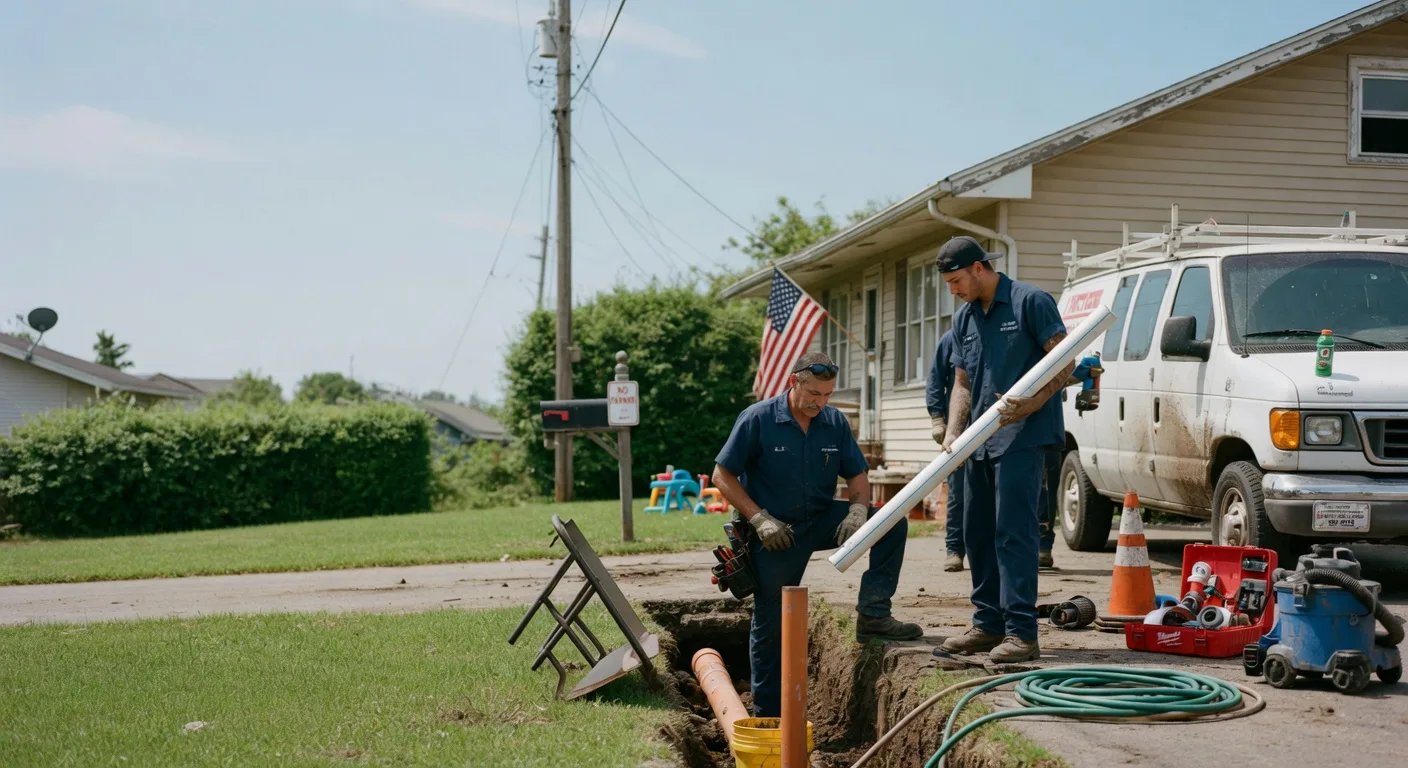
What is a bellied or sagging sewer line, and can it be cleaned?
A belly is a low spot in the sewer line where the pipe has sunk. Water and waste stop and sit in the dip instead of flowing on. Solids settle there, grease coats the pipe wall and paper catches. You see it as drains that run slow, a toilet that needs repeated flushing, or a line that clogs again a few weeks after it was cleared.
The cause is usually a pipe that lost support underneath it, or a joint that shifted.
Can it be cleaned? Yes, up to a point. A cable machine can open a blockage sitting in the belly, and hydro jetting can wash grease and buildup off the pipe wall. Neither fixes the dip. The belly keeps holding water, so the buildup returns.
A camera inspection tells you the rest. It shows how deep the belly is, whether the pipe is cracked, and whether roots have entered a joint. Cost depends on how deep the line is, how much has to be dug up or removed, the materials involved and any permit.
Safe homeowner check: note whether one fixture or the whole house is slow. One fixture points to its own branch. Every drain slow points to the main line.
Stop running water and call now if sewage is coming up in a tub, shower or floor drain.
Expert Plumbers Co is a referral service. Call (380) 262-9173 and we will connect you with a plumber serving Westover, PA for Drain Cleaning or Emergency Drain Cleaning.
Left alone, a belly tends to get worse in a predictable way. The standing water softens the soil around the pipe further, the dip deepens, and the clogs come back faster each time. Another warning sign is a faint sewage smell in the yard or a patch of lawn that sinks or stays wet, which can mean the pipe has separated at a joint. Older homes with clay or cast iron lines are the most likely to have a belly, because those pipes sit in sections and shift as soil settles. Newer plastic lines can also sag when the trench bedding was uneven. When you speak to the plumber, ask what the camera shows about the depth of the dip and the condition of the pipe at that spot. If the pipe is intact, a spot repair may be possible. If it is cracked, replacing that section is the lasting fix.
We just built or remodeled and the drains are already slow. Why?
The plumbing is new, and the tub drains like an old one. Or the sink gurgles whenever the washer runs. New work should not do this, and the cause is usually in how the pipe was set.
Four causes come up. First, not enough fall on a horizontal run. Water needs slope to carry solids, and a flat run leaves them behind. Second, a vent that was never tied in or was capped. The line cannot breathe, so you get gurgling and slow flow with no clog. Third, construction debris left in the line: grout, drywall mud, thinset, sand. It sets hard on the pipe wall. Fourth, a trap arm run too long.
One slow fixture points to its own trap arm, slope or vent. Several fixtures slow together, or the lowest drain backing up, points to the main run, a debris plug or a vent problem.
Safe homeowner check: note which fixtures are slow and listen for gurgling. Do not climb onto the roof. Stop running water and call now if water or sewage comes up in a tub or floor drain.
A camera inspection is the right first step on new work. It shows a flat section, a ridge of hardened material on the pipe wall, or a vent that never connected. Repeat cabling just pokes a hole through the problem, and it returns. A cable machine is enough for a soft, loose blockage. Hardened cementitious debris often needs hydro jetting. Slope and vent faults need the piping corrected, and what that involves follows access, materials, how much has to be opened up, and any permit or inspection.
Expert Plumbers Co is a referral service. We refer homeowners in Westover, PA to an independent local plumber for Drain Cleaning and Emergency Drain Cleaning. Call (380) 262-9173.
Keep a record while the work is fresh. Photograph any open walls or trenches before they are closed, and write down the date the slow drains first showed up. If a builder or remodeling contractor did the work, the fault may be theirs to answer for. A written note from the plumber describing what the camera found, such as a flat section or hardened debris, helps far more than a general complaint.
Tell the plumber when the work finished, which fixtures were added and whether the main line was touched.
A common mistake is pouring strong drain chemicals into a new line. They rarely touch hardened grout or thinset, they can damage fittings, and they make later cabling or jetting unsafe for whoever handles it. Another is waiting for the problem to settle. Construction debris does not wash away. Ask whether any air admittance valves were used in place of a full vent, and whether local code allows them.
My bathroom sink drains slowly but the stopper is clean. What else could it be?
If you have pulled the stopper and cleaned off the hair and soap film and the sink still drains slowly, the restriction is further down. The stopper mechanism is only the first few inches. Most of the slowdown lives in the pivot rod area, the tailpiece, the trap, or the pipe beyond it.
The common cause is a layer of soap scum, toothpaste and hair that binds together on the pipe wall. It narrows the pipe a little each month, and the sink slows long before it stops.
Safe checks you can do: set a bucket under the sink and unscrew the trap. Clear out what you find and rinse it. Look at the short pipe going into the wall for build-up you can reach with a bottle brush. Fill the basin and let it run, then watch whether the water drains evenly or with a gurgle. Skip chemical cleaners, which can soften plastic fittings and leave caustic liquid sitting in the trap.
Gurgling is a clue. A sink that drains slowly and gurgles can point to a blocked vent, because the drain cannot pull air behind the water. If the toilet or shower near that sink also acts up, the blockage may be in the shared branch line or the main drain, not the sink itself.
One slow sink with everything else normal usually means a local clog, and a cable machine through the trap arm is enough. If the pipe clears and slows again within a few weeks, a camera inspection can show whether the pipe wall is scaled over or has a sag that holds water. Heavy scale or soap buildup in the branch line may call for hydro jetting.
Call and stop using the sink if you see water leaking from the trap or the wall, if sewage smells from the drain, or if several drains in the house slow at once. That pattern usually means the main line is partly blocked.
Cost depends on how easy the pipe is to reach, whether the cleanout is nearby, how far the plumber must run the cable, and whether any worn pipe has to be replaced.
Expert Plumbers Co can connect you with an independent local plumber in Westover, PA when you call (380) 262-9173.
My house is old and the sewer might be Orangeburg pipe. What does that mean for cleaning?
Orangeburg is a pipe made from wood pulp fibers pressed together and sealed with pitch, also called bituminous fiber. It was used for house sewer lines in the middle of the last century, and some homes still have it between the building and the street. It was never as strong as clay, cast iron or modern plastic.
Over time the pipe softens and loses its shape. It can turn oval, sag, flake at the inside wall or collapse. Joints are easy targets for roots. So an old house with repeated backups and a history of roots or low spots may be sitting on this kind of line, though only a camera can confirm the pipe material.
That matters for cleaning, because the usual tools are rougher on Orangeburg than on other pipe. A heavy cutting head on a cable can tear at a soft wall. High pressure from a jetting nozzle can strip layers off or push through a weak spot. A plumber who knows or suspects the material will start with a camera inspection, use gentler tools, and avoid forcing a machine through a section that has already deformed.
Tell the plumber on the phone how old the house is, any earlier line repairs, and whether the line has been cleaned before. If you can, mention what you have seen: slow drains, a repeat clog, wet soil over the line.
Safe checks you can do:
Ask whether any earlier paperwork notes the pipe type. Limit water use if backups are frequent.
Stop running water and call now if sewage is coming into the house or the yard.
Cleaning may buy time on a line in fair shape, but it does not strengthen the pipe. If the camera shows a collapsed or badly ovaled section, the realistic options are lining where the shape allows it, or replacing the line. Cost depends on pipe length and depth, access, what has to be dug or removed, the repair method and permits under local code. To be connected with an independent local plumber in Westover, PA, call Expert Plumbers Co on (380) 262-9173.
The plumber suggested a smoke test. What does that find that a camera does not?
Your plumber says "let's do a smoke test," and you wonder why, when a camera already looked in the pipe. The two tools answer different questions, and the smoke test finds things the camera cannot.
A drain camera travels down the inside of a line. It shows roots, grease, scale, a belly holding water, an offset joint or a crack in the section it can reach. But it can only go where the cable can push it. It cannot climb a vent stack in a wall, it tells you little about the vent side of the system.
A smoke test pushes non-toxic smoke through the drain and vent system under light pressure. Wherever the system is not sealed, the smoke shows itself. It can come out of a cracked vent pipe in the attic, a missing cleanout cap, a broken pipe inside a wall, or a dry trap. That explains symptoms a camera often misses: sewer smell with clean-looking drains, gurgling fixtures, and slow drains caused by a blocked or damaged vent.
One fixture that drains slowly is usually a local clog and rarely needs a smoke test. Sewer odor in several rooms, gurgling at more than one fixture, or a smell that has no clear source points at the system as a whole, and that is where the smoke test earns its place.
Safe homeowner check: pour water into every floor drain and rarely used sink so the traps are full, because a dry trap can mimic a leak.
Stop running water and call now if wastewater backs up in a tub, shower or floor drain, if the toilet will not clear, if you see wet floors or stained ceilings, or if the smell is strong enough to make anyone dizzy or sick. Leave the area and ventilate it first.
A cable machine is enough when the problem is a plain clog. If the smoke test shows a vent or pipe defect, the job becomes a repair, not a cleaning. If the line is coated with grease or scale, hydro jetting may be proposed. If the cause is still unclear, a camera inspection on the drain side often pairs well with the smoke test.
Expert Plumbers Co is a referral service. We connect you with an independent local plumber in Westover, PA. Call (380) 262-9173.
Ask the plumber what they are trying to confirm and where the smoke came out. Ask whether the vent, a wall section or the main line needs repair, and whether a camera pass should follow. The scope depends on access to the pipe, the parts or pipe needed, how much wall, ceiling or floor must be opened, and any permit or code requirement.